Saturday, February 21, 2015

Never Satisfied! (Re-did The Swedish Fish cover)


I wasn't entirely satisfied with the Swedish Fish cover. Something about the balance, the resolution, the font choices... whatever it was... it just wasn't clicking in my mind. Every time I looked at it, I thought, it's almost something good. But it didn't have that little extra oomph needed to make it pop. So I tried some things, tweaked it, played with it a bit, and presto, poof, a much nicer cover!

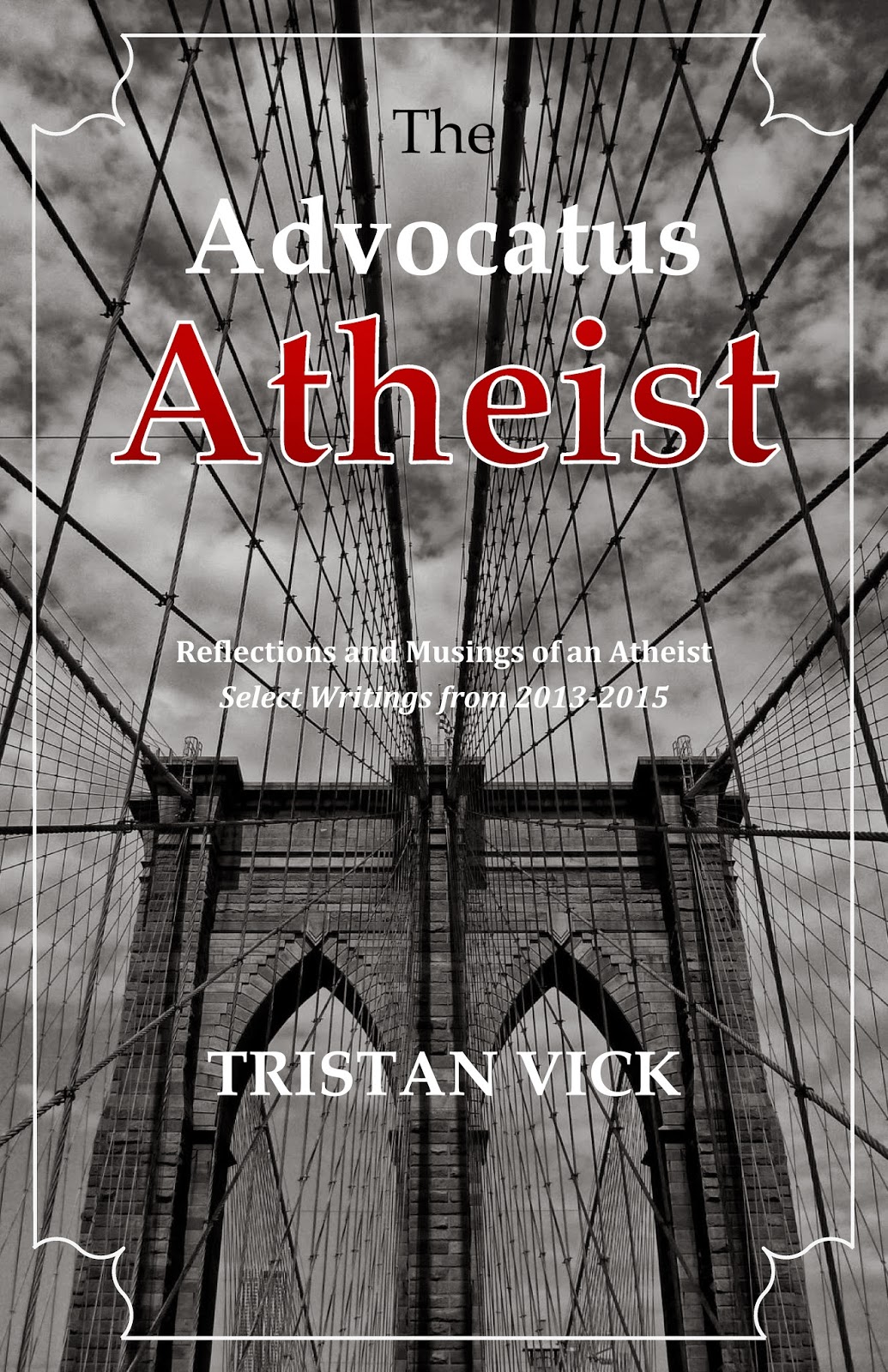
Now We're Talking! (Advocatus Atheist: The Book)

I am going to have the E-book ready for a March 1st release. Stay tuned for updates on that and the eventual paperback release!


Friday, February 20, 2015

A New Book ... Already?!


I was browsing through the few years of blog posts here at The Advocatus Atheist and felt they dovetailed nicely in terms of tone and style. 

The subject matter is less about religious criticism and more about being self reflective. It reads somewhat as a memoir and something like a personal journal of my thoughts and opinions regarding a full range of topics. 

Naturally, I thought it would be fun to put the best of the best over the past 3 years into a book and publish it just for the hell of it. Here's the mock cover I whipped up. I kind of like it.

As for which essays and articles I chose to include, they are as follows:

  1. Preface
  2. Why Are Atheists So Angry? 
  3. Why I Ran Away from Christian Apologetics 
  4. Answering an Agnostic in Crisis 
  5. On Pro-Choice: Why It’s the Only Moral Choice 
  6. Belief Doth Compel Thee 
  7. Questions About God 
  8. On the Ben Affleck, Bill Maher, and Sam Harris Debate (Debacle) 
  9. To Whom It Offends 
  10. Ignosticism: A Short Recap (What do you mean by “God”?) 
  11. A Frightening Epidemic: America’s Obsession with Religion 
  12. Why Advocate (Promote) Atheism? 
  13. Authenticity: Reflections on Why I Lied to Myself 
  14. Why I changed My Mind About Marriage and Monogamy 
  15. Corporal Punishment is Wrong 
  16. Christian Spammer Girl 
  17. Happy Draw Muhammad Day! (May 20th) 
  18. Book Banning Gets My Goat 
  19. Jesus the Corn King 
  20. If You Don’t Have Faith: Then What Do You Believe In?


Thursday, February 19, 2015

Why are Atheists so Angry?


It's often said that atheists are angry. Especially the Internet "village atheist" sorts who gravitate toward certain firebrands and gather online to bash religion.

I could see how that might make atheists appear angry.

We're always so worked up about everything that we constantly need to vent.


But maybe that's healthier than keeping it all inside?

After all, many of us suffered decades of religion -- and some experienced genuine trauma and hardships -- so, I think it helps to talk about it. Such anger, the kind that lets us get it off our chests so we can begin the healing process, is a positive thing. It's how we cope with the psychological damage. In fact, I am personally still coping with how religion ruined my views of sex and relationships. It's not always an easy thing to get over.

For a long time after my deconversion from Christianity, my family and friends (most of whom were highly religious) said I became overly argumentative and seemed angry all the time.


Was I being belligerent? Was I being nasty, vindictive, or puerile (as someone recently put it)?

I don't think so. Not really anyway. I was just asserting what I believed when everyone else was doing the same, then they all looked at me funny because I disagreed with them. And because they didn't want confrontation, but they didn't want to accept my worldview either, they attempted to marginalize me. And that may have made me a little bit angrier than I would have been if they just had shrugged their shoulders and let bygones be.


It took me a long time to learn to just, in the words of the Beetle's, let it go.

I think another reason that this "angry atheist" stereotype gets perpetuated more than it probably should is because those of us who are vocal in the atheist community will often express our displeasure at the things said or done by the religious in the name of religion which they do without any consideration for anyone who might think differently that they do. 


Being in the majority, and I'm thinking of the big religions of Christianity and Islam here, many religious believers take it for granted that others might not share their views.

Usually that forces atheists to be in the uncomfortable position of having to stick out like a soar thumb when we refuse to bow our heads and pray at the dinner table, or when we don't pray with our sports teammates, or when we don't stand to say the pledge of patriotic allegiance because it contains ad-hoc additions of hyper religious speak which says we must submit to God, or when we don't go to prayer call, or when we don't abide by the religious holidays, or when we don't take guff from religious people who try to proselytize and changes us rather than try to accept us for who we are.

I see how this might make atheists seem like party poopers who just want to rain on everyone's parade. I get it, I do. But that's not really what we're doing. We're not setting out to ruin your happy God-filled day. Have your beliefs, pray the way you want, but don't expect to force us to do the same.


The way I see it, this is where most of this tension arises. The religious majority want everyone to conform, to be like minded, and to kneel before God. Atheists are like cats who just want to do there own thing and don't want to be bothered too much. 

Conformity is part of how religions have traditionally identified  heretics and apostates. If you can hammer someone into place, get them to sit down and shut-up, then there won't be any rocking the boat. Religions seek conformity because it means the religion has a better chance of weathering change. 

Furthermore, it's why concepts like blasphemy get taken seriously mainly only in religious circles, because labeling someone a blasphemer is a most serious accusation for a person of faith, because it comes with the slam of a hammer, the lash of a whip, or a death sentence. The authoritarian will to put you into your place, and the fear of what would happen if they didn't, is sadly often considered greater than your right to be freedom. 

Meanwhile, blasphemy is a concept that also safeguards the religion from having to deal with different ways of thinking, ways of life, or diverging worldviews. It's why blasphemy is such a hot topic issue today -- many religious adherents in some parts of the world want to impose it on the non-religious, secular, or free thinking peoples of differing faiths -- so as to say that anytime you offend their religious sensitivities -- they reserve the right to hammer you down.

Blasphemy thus has become a tool of the autocratic demagogues who want to rile their fellow religious comrades into a frenzy to go on witch hunts for anyone they imagine has slighted them in some way, and enslave everyone to their way of life. It's why blasphemy is an evil, vile, manipulative, damaging concept that carries with it all the potential for the worst kind of human atrocities minus any redeeming quality whatsoever. 

Blasphemy seeks to eliminate the freedom of speech and pull everyone back into the dark ages. Blasphemy is a tool with one purpose, to shackle our tongues and our minds and make slaves of us all. It is why blasphemy must be opposed and contested at every turn.

So, you see, maybe -- just maybe -- telling atheists we need to pipe down and let the religious dictate how we ought to live or be, well, sorry -- that makes some of us angry.


Just the other day a religious apologist accused me of having blasphemed -- and I could only think of one thing to say to him -- a wholehearted "Fuck you. And fuck your God too."

Which, in retrospect, probably made me seem a little bit angry. But can you blame me?

Another reason I think many view atheists as angry is because many atheists tend to be critical. That is, we're not content to just sit by the side and watch the privilege religious class turn our society into a ruling theocracy. We want better educations for our children. We want better rights for women. We want equality and tolerance, and we'll gripe about any of the religiously motivated policies that try to strip these things from us or simply make it harder to achieve.


In other words, we're not afraid to stand up for ourselves. We'll tell you when we think you're being an idiot, and well, that might seem angry to some.

It might even seem nasty, puerile, or vindictive.

But maybe, just maybe, if you treat us like children, we'll act puerile to make a point, and if you dismiss us and try to force policies on us we don't need or want we will get nasty about it, and maybe if you violate our freedoms and try to take away our rights so as to force us to conform to your beliefs, well, perhaps our vindictiveness is vindicated.

So we gather online, voice our discontent, and then get labeled angry atheists.

That's fine, as long as you admit that maybe, just maybe, some of it was provoked.

Why I Ran Away from Christian Apologetics and Never Looked Back


One thing you may not know about me is that I trained to be a Christian apologist. My sophomore year of college I was enrolled in several theology classes, a few biblical history courses, and was in the process of switching my major to Religious Studies.

Luckily one of my professors, a Professor of Religion, strongly urged me not to do it. 

He said that in academia religious studies was already pretty much a dried up area of research -- that is, there was nothing new to learn. He added that there were virtually no job opportunities in the field apart from being a religious apologist, and he couldn't bare to see me waste my gift of words in such a way that I would never gain recognition for the talent he saw in me.

I listened, because I really respected this teacher and his words of wisdom. He knew more about religion than anyone I've ever met, and he was telling me that if I became an apologist I would never reach my full potential. I'd get stuck rehashing the same old arguments over, and over, and over, and over, and over again -- like most apologists do -- never to have an original thought again.

I asked about a theology degree, and he said there were even less jobs in that area, unless I wanted to become a priest or try really hard to get a professorship in a field where there are thousands of theology graduates bidding for a single position at that one university nobody has ever heard of.

I didn't like the idea of having to fight for table scraps, so I decided to get a history degree instead. I ended up getting two degrees, actually, one in Asian Cultural Studies with a focus on Japanese History and one in English Literature. (Later I'd go to college in Japan and get a certificate in Japanese language from a Japanese university -- kind of like a minor degree.)


I toyed with the idea of getting my PhD for a while, but decided against it. I have far too many interests. My tastes are eclectic and I'd rather be a Jack of all trades, so to speak, then get tied down with one occupation that becomes my life's major preoccupation. I want to be free to explore, and learn on my own terms. That means I'm sort of a Maverick when it comes to education. But this might explain why I ultimately decided to be a teacher.

I teach K-12 in a foreign country. Obviously I teach English. I came to Japan and taught ESL on the JET Programe, but I have since branched off into the private sector and now am employed by a local municipal BOE in the Prefecture that I live in. 

I have been a teacher for ten years now, and I love educating children. It's one thing to get English speaking natives excited about learning English, it's entirely another to get people who don't even know how to speak it excited about it. But I digress.

So, looking back, I almost made the choice to become a Christian apologist. I even ran an apologetics blog called The Chronicles of a Sympathetic Christian in which I tried to reach out toward Internet atheists. Sound familiar?

I've read about a couple dozen strict apologetics books, you know -- the usual suspects, Karl Keeting, C.S. Lewis, G.K. Chesterton, Norman Geisler, Josh McDowell, Lee Strobel, William Lane Craig, Alvin Plantinga, and so on.


Some apologists are better than others. Some obviously went through a diploma mill. Others seem to be scholarly enough to count as real academics. I wanted to be the latter. I wanted to be one of the smart, front-line soldiers Evangelizing to the gentile. I wanted to be The Great Defender of Faith just as Robert G. Ingersoll was The Great Agnostic and champion of Freethought.

Granted, at the time I have never read a single Free Thinker's work. It wouldn't be until 2006 that I'd actually sit down and read Paul Thiry D'Holback, G.W. Foote, Robert G. Ingersoll, Thomas Paine, and the letters of Thomas Jefferson. (Although not technically a part of the Free Thought movement, Freidrich Nietzsche has been a major influence on my thinking as well.)

In 2009 I finally gave up my Christianity and so too my dream of becoming an apologist. But I had read enough apologetics, and had argued nonstop with angry Internet atheists since 2005 to be familiar with all the arguments. 

When I hear Christian apologists talk now, I just roll my eyes. Their arguments are simplistic. They make rationalizations that are easier to poke holes in than a sheet of rice paper. They like to use a sophist and flowery language which hearkens back to the time when people actually read pastorals for pleasure, but without the content or eloquence. They believe their arguments constitute hard evidence, but if you show fault in their logic or reasoning they get overly defensive.

More recently, from about 2011, I began poking every online religious apologist I could find with a stick. If they engaged me, as I knew they couldn't resist a chance to proselytize to the angry atheist (after all, I used to be in their shoes!), then I took great pleasure in tearing their arguments to shreds in less than a couple paragraphs.

After a couple of years of this I grew tired of grinding the grindstone for no reason than just to hear the grating scrape of stone on stone. I realized I wasn't accomplishing anything, because, well, I found out one undeniable fact about religious apologists: the refuse to listen.

Now, I don't mean this as in they don't let you talk (although they often like to flood a thread post and always seem to want to have the last word) but they honestly do not reflect on the opposing position or point of view offered them. They hear nothing about what the other side might be trying to say, and they ignore any attempt of others to be reasonable with them, they are dismissive, and when you get annoyed by their obnoxious behavior of simultaneously trying to be the loudest in the room and the most dismissive, they act victimized when you snap at them.

If you mock or ridicule the apologist, they like to try to use this as an example of you being immoral, even though all you may have been doing what showing that their rhetoric is empty. If you put too much rhetoric in your own arguments they think you're being insincere, which gives them another reason to be dismissive of you.

On and on it goes. 


Then it dawned on me. It's not that they are trying to push their beliefs and don't want to seriously engage in any meaningful conversation with those who hold opposing views, it's that they don't know how.

They only know how to peddle a belief. They don't know how to reason through an argument to settle on a reasonable conclusion. This may sound like a harsh claim, but it's true. I have a decade of apologetic experience -- I've walked down that road -- I know it's a dead end.

And that's what I feel has happened to most religious apologists. They've all come up against that dead end, and instead of turning back and looking for a different, perhaps more enlightening path, they continue to bounce up again the wall that marks the dead end.

I realized that if I continued to engage apologists as I had been, I'd only be stuck in that mosh pit with them, bashing up against the wall, having my brains and any sense I may have once had spill out onto the floor.

 It's why I refuse to deal with religious apologists today. But I wrote The Swedish Fish, Deflating the Scuba Diver and Working the Rabbit's Foot in response to one apologist because I wanted to show that, no matter who you are (whether a professional scholar or an armchair philosopher), if you stop to reflect, to think through the arguments, to ponder the big questions, to reason, and to try to see the big picture -- then you'll have more than enough reasons to leave apologetics behind.


The search for answers to our questions will compel us forward. Pretending we have all the answers and apologizing for why they don't seem to answer anything won't -- that just leads to the dead end, I'm afraid. 

So, I won't apologize for apologists. I won't even take them all that seriously. Even if they prove to be good scholars, or have higher degrees, or more credentials than I do, that doesn't change the fact that at the end of the day -- they're still smashing up against that wall like a bunch of lemmings dashing mindlessly to their intellectual doom. And that's something I want to avoid.


QOTD: Procrastus

A commenter over at Debunking Christianity using the handle Procrastus paid me one of the best compliments I've ever recieved.

"I read Vick's response to Rauser's book when he published it in serial format on his web site a year (?) or two (?) ago. Good stuff. He's got a penchant for taking complex philosophical concepts and explaining them in a way that's understandable to those of us who do not have PhDs in philosophy. I worked for 30 years in college textbook publishing and Vick is the kind of author we always looked for - someone who had an excellent grasp of the subject matter and could explain concepts in a clear and concise way that undergraduates, exposed to the discipline for the first time, could grasp. The "best" textbooks, as determined by which sold the most copies, were usually NOT written by the most famous researchers and academics in the field. Some of the best-sellers were written by people teaching at community colleges or average state colleges and were aimed at their students, not professionals in the field. Tristan, I think, missed his calling in life - though it is a long paper chase to land a tenured position in any college these days. Anyway, looking forward to adding this to my bookshelf."

I'm very humbled and flattered. Thank you for making my day.

Wednesday, February 18, 2015

The Swedish Fish: Chapter 13: Which Pill Will You Choose? The Red or the Blue?


13


Which Pill Will You Choose?
The Red or the Blue?


Our friend Sheridan, the quintessential atheist, posits that consciousness is a byproduct of neurons firing in the brain, like smoke is a byproduct of fire burning. Randal informs his atheist friend that epiphenomenalism isn’t so simple, and that it’s greatly complicated by “free will.”
Before I get into chapter fourteen, “The Pastry I Freely Choose,” and Randal’s discussion on free will, let us just take a moment to reflect on the fact that traditional epiphenomenalism has largely been rejected.[1] The theory of mind and along with it the modern branches of cognitive science, including neuroscience, have mainly evolved out of our desire to tackle and answer this question. Meanwhile, free will is still nowhere near a given. At best, the existence of free will is still an open-ended debate.[2]
Furthermore, it could be that both positions are mistaken, as the philosopher Daniel Dennett has cautioned in his book Consciousness Explained, that both ideas of epiphenomenalism (i.e., the belief that mental events are completely dependent on physical functions and, so, have no independent existence or causal efficacy) and qualia (i.e., a term used in philosophy to refer to the intrinsic nature of individual instances of subjective, conscious experience, such as beholding the redness of a sunset) may simply be category mistakes. He rejects them on the same grounds that the British philosopher Gilbert Ryle rejected the Cartesian “ghost in the machine.”[3]
Randal’s mistake seems to be a continuation of the category mistake he seemingly made earlier where he holds that understanding how a thing functions and the utilization of a thing’s function are the same. As the car analogy showed in the previous chapter, understanding how a car engine works doesn’t necessarily equate to knowing how to drive a car. Once again, it seems that Randal is either unfamiliar with functionalism, or he just doesn’t want to acknowledge it here because it would act as a defeater to his premise about the mind and soul being independent of the body.
Functionalism, or more specifically, homunculi functionalism, is the idea that an intelligent system, or mind, may be thought of as the result of a number of sub-systems performing more simple tasks in coordination with each other. The subsystems may be envisaged as homunculi, or small, relatively unintelligent agents. The example often used in comparison is a digital computer, where a battery of switches each capable of only one binary response (on or off) can make up a machine that can play chess, compete on the game show Jeopardy, and perform other complex functions.[4]
Randal turns our attention to Dr. Ferry, who enters the coffee shop and orders a cinnamon bun. Randal goes on to say that we cannot account for Dr. Ferry’s desire for the cinnamon bun, and adds that all the firing of neurons and motor functions amount to is the action of achieving the goal of the desire, but do not explain the desire itself. Randal says, “You’ve got to look to Dr. Ferry’s mental intention to order a cinnamon bun because he wanted one.”
Randal is only partially right. Desirism is a burgeoning area where moral philosophy and modern mind theory intersect, and it is still an active area of discussion, but it is my understanding is that there are and always will be numerous physiological triggers such as hunger, or simply having a sweet tooth, along with reactions to certain tastes and smells, our bodies’ reliance on things like caffeine, our level of tolerance to pain, etc. which all impact our everyday desires.
In fact, desire can be manipulated by physical changes in diet. For example, my strict vegan friends have reported that after several years the smell of meat and cheese can become repellent. Things like a juicy cheeseburger, a block of tangy red cheddar, or a nice carbonara pasta which once made one’s mouth water in anticipation can become disgusting turn-offs due to the change in diet and subsequent change in physiology.
Look at people who are lactose intolerant. They may have less of a desire to consume dairy than others since they have an underlying physiology which yields a negative physical response to consumption of dairy products. The same can be said for those who have other food allergies, such as being allergic to nuts.
Right now, this very moment as I write, I desire a Coke. But this has more to do with my body’s addiction to sugar and caffeine than some unmet inclination that wafts around in the ether of some vague, imperceptible metaphysics.
Thus it seems that either desiring to have a glass of milk or a Coke, for example, or not desiring to have a glass of milk or a Coke, depends on pre-existing physiological conditions, such as whether or not you are lactose intolerant or have a sweet tooth.
Regarding Dr. Ferry’s ordering of the cinnamon bun, Randal informs us that

It’s because he wanted a cinnamon bun that a particular pattern of neurons fired, causing his finger to tap the glass. And it’s because he wanted to express this intention that more neurons fired, thereby causing him to vocalize the desire to have one…

Again, this seems to ignore the underlying physiology I mentioned above that gives rise to the craving in the first place. Worse yet, Randal continues to speculate on unknowns which fly in the face of our current scientific understanding. Personally, I don’t think Randal knows what he’s talking about here, and I would take everything he says with a grain of salt (another thing people often find they have an overwhelming desire for).
Referring to his previous comment, Randal asserts, “So that’s two reasons to support the existence of a mind or soul.” And if hasn’t sunk in yet, Randal states it one more time for the record:

First, conscious experience is something more than the activity of the brain. And second, our minds interact in the physical world. This means that we have at least one example of a non-physical substance—mind or soul—that interacts with the physical world.

Notice that in a single sentence Randal has conflated mind and soul to mean basically the same thing. Randal continues:

And if souls can exist and interact with the world then why not think that God could be another non-physical substance that interacts with the world?

If the mind exists as a metaphysical state and not a physical state, this doesn’t prove the soul exists as Christians define a “soul” or a “spirit”. All it means is that the mind doesn’t have a direct physiological or biological reason for existing—that is, it exists apart from the natural world rather than as a part of it. Although this isn’t at all clear, what is clear is that the mere existence of a metaphysically derived mind speaks to nothing about the validity of the Christian concept of a soul.
Another way to look at it would be to consider that if one day we discovered real magic beans with magical properties, it wouldn’t automatically mean that man-eating giants live high above us in cloud cities. But if you were going by Randal’s logic you would be entitled to make that very inference, since according to him discovering a disembodied mind would constitute evidence for things like the soul and God.
Without compelling evidence, however, that’s all that needs to be said on the subject of souls and disembodied minds.


[1] To learn more about epiphenomenalism and its problems, read about it online at the Stanford Encyclopedia of Philosophy at:
    http://plato.stanford.edu/entries/epiphenomenalism/
[2] Even nonbelievers are interested in the free will debate. Most recently, the cognitive scientist and philosopher Daniel C. Dennett, who has written extensively on the subject, published his review of the neuroscientist Sam Harris’s book on free will by the same title.
Interestingly enough, these gentlemen take opposing views. You can read their rather lengthy discussion online at:
    http://www.samharris.org/blog/item/reflections-on-free-will
Sam Harris’s rebuttal to Dennett’s response can be read at:
    http://www.samharris.org/blog/item/the-marionettes-lament
[3] Daniel C. Dennett, Consciousness Explained, pp. 401-405.
[4] For more on Functionalism, please feel free to head over to Wikipedia and read the overview:
    http://en.wikipedia.org/wiki/Functionalism_(philosophy_of_mind)

THREE REASONS I.C.E SHOULDN’T EXIST (The Aftermath of Renee Good's Killing)

“Political language is designed to make lies sound truthful and murder respectable, and to give an appearance of solidity to pure wind.” ― G...